Enjoy the Garden in Winter

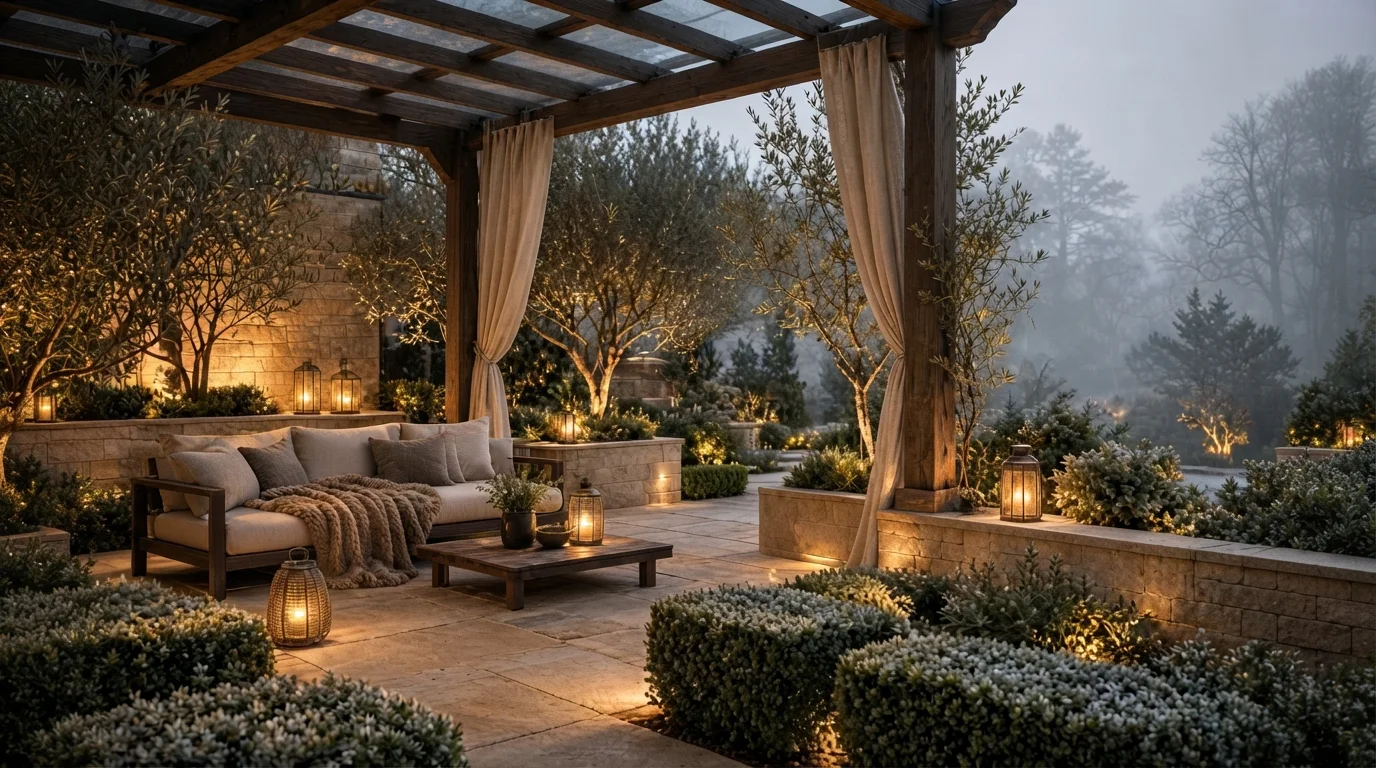
Elegant winter garden with sheltered seating, evergreen planting, natural stone, and warm architectural lighting

Why Not Enjoy the Garden in Winter?

Winter has a way of changing our relationship with the garden. The light becomes lower and more revealing, foliage loses its summer abundance, and outdoor spaces often retreat from daily life. Yet this seasonal quiet can reveal another kind of beauty—one shaped by texture, atmosphere, warmth, and carefully considered architecture.

A well-designed winter garden is not simply a garden that survives the colder months. It is an outdoor room conceived to be experienced throughout the year. With the right combination of planting, shelter, materials, lighting, and places to gather, the garden can remain as relevant in January as it is in June.

This shift matters because contemporary residential design increasingly treats the landscape as part of the architecture rather than a decorative boundary around it. The garden becomes an extension of the living room, dining area, or retreat—a space that can support everyday rituals even when temperatures fall.

The Garden Was Never Meant to Belong Only to Summer

The idea of experiencing nature throughout the year is hardly new. Traditional gardens across Europe and Asia were designed around seasonal change, with winter valued for its particular qualities rather than treated simply as an absence of summer.

Japanese gardens, for example, have long emphasized structure, negative space, moss, stone, evergreen plants, and the changing character of light. In European landscapes, winter gardens and orangeries emerged as architectural spaces where plants, people, and climate could be brought together. During the 18th and 19th centuries, conservatories became symbols of technological progress and refined domestic life, allowing exotic plants to flourish while creating an environment in which residents could remain close to nature during colder weather.

Today, the technology is more sophisticated, but the underlying principle remains remarkably familiar: architecture can mediate between the interior and the landscape.

The contemporary winter garden takes that idea further. Rather than enclosing the garden completely, designers often work with partial shelter, covered terraces, glass walls, pergolas, fireplaces, wind protection, and carefully positioned planting. The objective is not to eliminate winter, but to make it inhabitable.

What Makes a Winter Garden Successful?

A successful winter garden begins with a simple question: what would make someone want to stay outside when the weather is less forgiving?

The answer is rarely a single feature. Comfort comes from several architectural decisions working together. A roof can provide protection from rain. Planting can soften wind. A fireplace introduces warmth and a visual focal point. Appropriate furniture makes lingering possible, while lighting gives the garden a second life after sunset.

For landscape architects and residential designers, this layered approach is important because winter exposes weaknesses that summer can easily conceal. A terrace that feels generous in warm weather may become uncomfortable when exposed to prevailing winds. A beautiful planting scheme may lose its structure when deciduous foliage disappears. A poorly positioned seating area can become unusable as soon as the sun moves lower in the sky.

Winter therefore becomes a useful design test. If a garden remains inviting when conditions are difficult, its architecture has probably been carefully considered.
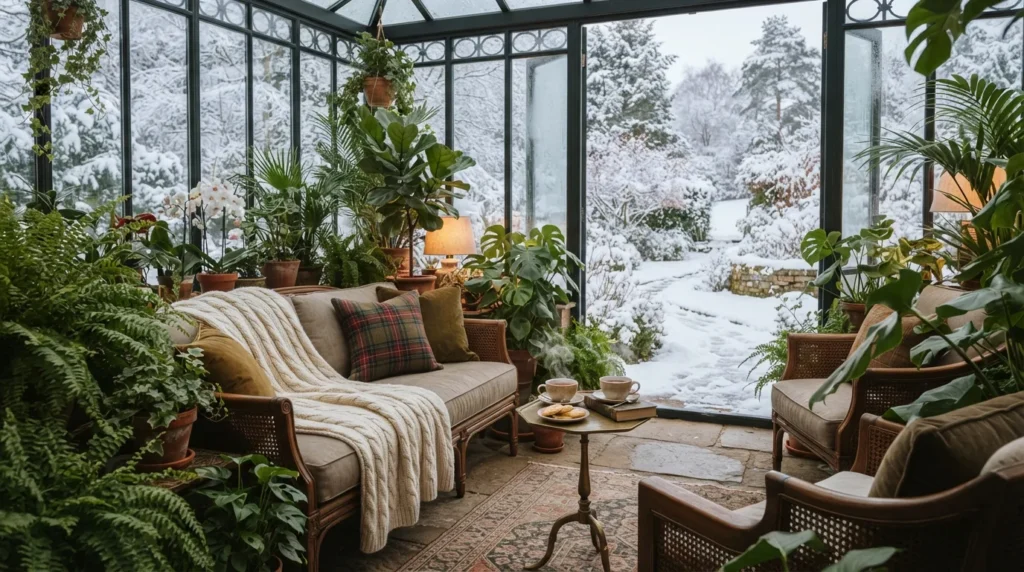
Cozy glass sunroom filled with indoor plants and wicker furniture, overlooking a snowy winter landscape.
A warm, inviting sunroom retreat amidst the winter snow.

Designing for Shelter Without Losing the Landscape

The most successful forms of winter outdoor living rarely rely on complete enclosure. Instead, they create degrees of protection.

A covered terrace can provide a threshold between house and garden. A pergola can frame the sky while reducing exposure to rain. A garden pavilion can offer a more substantial retreat, particularly when equipped with glazing or sliding doors. Even a strategically planted hedge can make a meaningful difference by filtering wind and creating a sense of enclosure.

This concept of graduated shelter is particularly valuable in luxury residential architecture. Rather than producing one large outdoor room, designers can create a sequence of microclimates: a sunny breakfast corner, a protected dining terrace, a fire-lit seating area, and a more open section for enjoying the landscape.

The result is more nuanced than simply adding a roof. It creates a garden with different atmospheres and levels of intimacy, allowing residents to choose how they want to experience the season.

Winter Planting Is About Structure, Not Abundance

Summer gardens often depend on abundance. Flowers, lush foliage, climbing plants, and seasonal color create an immediate visual impression. Winter asks for a different language.

A considered winter planting scheme relies on structure. Evergreen trees and shrubs maintain volume. Ornamental grasses introduce movement. Bare branches reveal sculptural forms that may disappear beneath summer foliage. Winter flowering plants provide moments of color, while berries, bark, seed heads, and persistent foliage create detail at closer range.

This is one reason experienced landscape designers think about winter from the beginning of a project rather than adding seasonal plants later. The garden must be designed around what remains visible when much of the landscape becomes quieter.

There is also an ecological dimension. Choosing plants suited to the local climate can reduce irrigation, chemical inputs, and maintenance while providing habitat and food for wildlife. A garden that looks restrained in winter can, in fact, be considerably richer from an ecological perspective.

In this sense, winter planting represents a broader movement away from gardens designed purely for visual performance and toward landscapes that support biodiversity, resilience, and long-term environmental health.

Materials Become More Important in Winter

When flowers recede and daylight becomes softer, materials carry more of the visual responsibility.

Natural stone, timber, brick, textured plaster, weathered metal, and handmade ceramics can introduce tactile depth into a winter landscape. Their character becomes particularly apparent under low winter light, when surfaces reveal shadows, grain, irregularities, and patina.

This is where craftsmanship can make a substantial difference. A hand-finished stone wall or carefully detailed timber structure does more than perform a practical function. It gives the garden a sense of permanence and material identity.

For high-end residential projects, material selection should also consider weathering. The most successful outdoor materials do not necessarily remain unchanged. They age gracefully. Timber develops a patina, stone acquires subtle variations, and metals can become more expressive over time.

Winter is therefore not simply a season to protect materials from. It is part of the environment that gives them character.
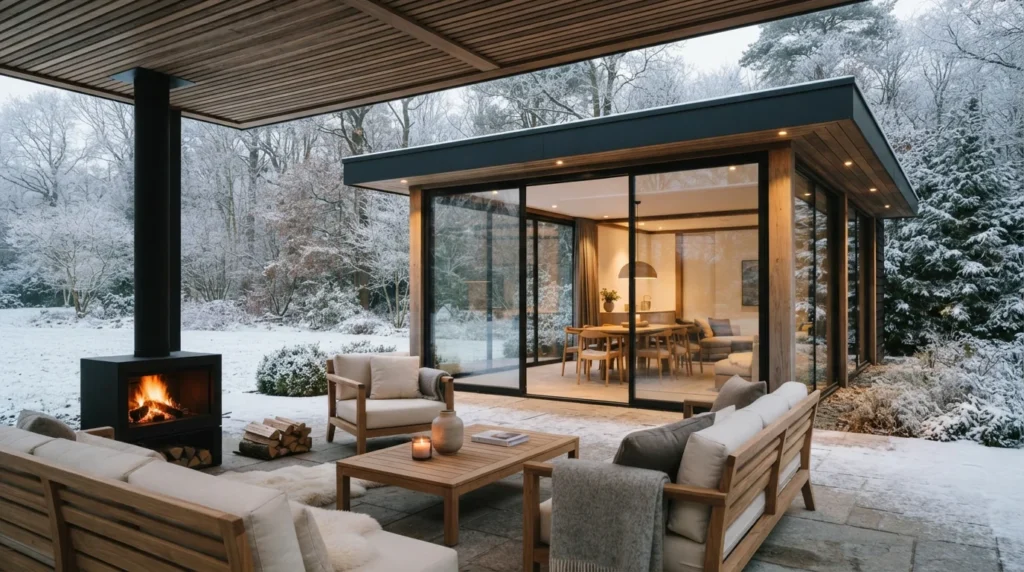
 Contemporary garden pavilion with glass walls, timber structure, and sheltered outdoor seating
A sheltered pavilion creates a comfortable threshold between architecture and landscape without severing the connection to the outdoors.

Warmth Is Both Physical and Visual

Temperature is an obvious consideration, but warmth in a winter garden is also psychological.

A fire pit or outdoor fireplace can become the social center of a terrace, drawing people toward it and creating a natural gathering point. Infrared heating can make covered areas more comfortable without dominating the architecture. Thick textiles, weather-resistant cushions, and layered seating can reinforce the sense of domesticity.

Yet restraint is important. An outdoor space should not attempt to reproduce an interior living room beneath an open sky. Its appeal lies precisely in the contrast between comfort and exposure—the warmth of a seat beside the coolness of stone, the glow of fire against a dark garden, or the sound of rain beneath a sheltered roof.

Good design does not erase the season. It gives the season a place within the experience of the home.

Lighting Gives the Winter Garden a Second Life

Winter’s shorter days can initially seem like a limitation. Architecturally, however, they create an opportunity.

With sunset arriving earlier, landscape lighting becomes part of the garden’s architecture rather than an occasional decorative addition. Low-level lighting can trace pathways without flattening the landscape. Carefully positioned uplights can reveal tree trunks and sculptural branches. Warm illumination beneath a pergola can create a sense of intimacy, while discreet lighting around steps improves safety.

The most sophisticated schemes are rarely the brightest. They use contrast. Darkness becomes part of the composition, allowing selected elements to emerge gradually.

This approach is especially effective in winter because the reduced foliage creates clearer visual relationships between trees, walls, buildings, and sky. A garden can appear almost theatrical after dark without feeling staged.
Creating Places for Everyday Winter Rituals

The most convincing argument for winter outdoor living is not the occasional celebration or special dinner. It is the ordinary moment.

A winter garden becomes genuinely useful when it supports small daily rituals: drinking coffee beneath a covered terrace, reading beside an outdoor fireplace, having lunch in the afternoon sun, watching rain move across the landscape, or stepping outside for a few quiet minutes at the end of the day.

Designers can encourage these habits by creating spaces with different degrees of exposure and intimacy.

  • A sheltered morning terrace can capture low winter sunlight.
  • A covered dining area can extend meals outdoors beyond the traditional summer season.
  • A fire-centered seating area can provide warmth and encourage conversation.
  • A garden pavilion can function as an outdoor study, reading room, or private retreat.
  • A framed view can turn a winter landscape into a changing piece of living art.
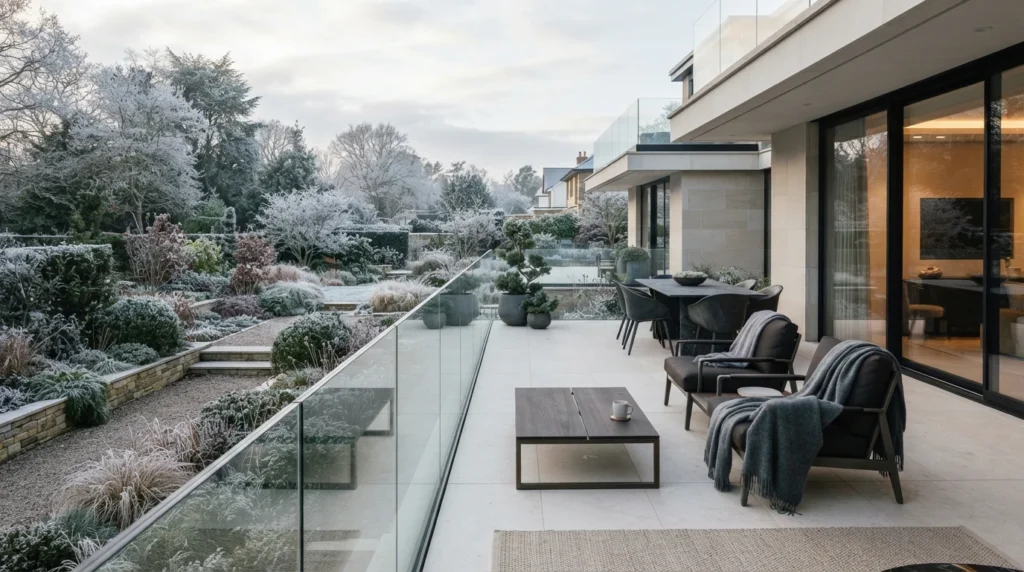
  • Luxury residential terrace overlooking a winter garden with layered planting and refined outdoor furniture
    A carefully designed terrace can make the landscape part of everyday life throughout the year.

The objective is not to maximize the amount of time spent outside. It is to make outdoor space feel naturally available.

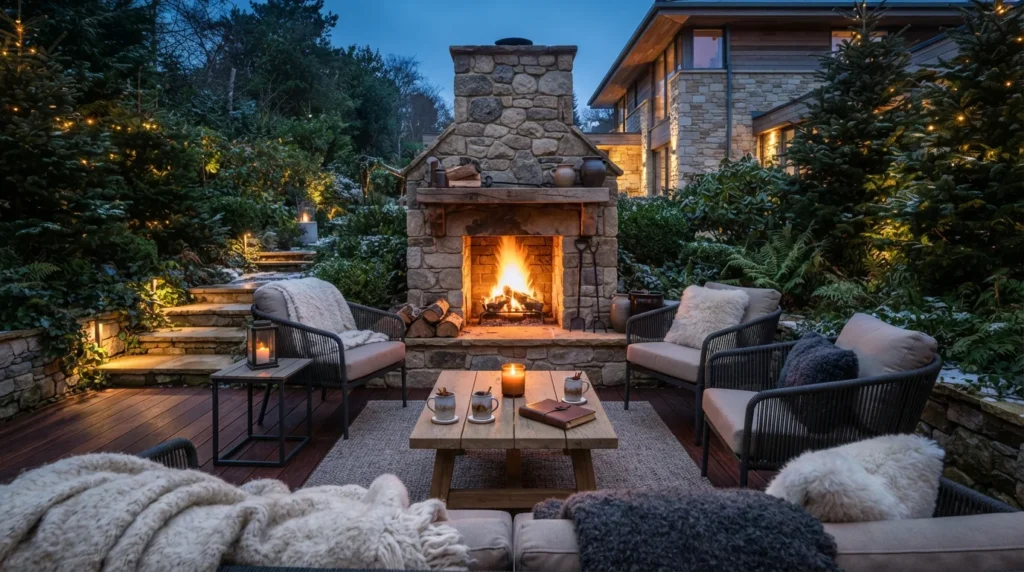
Refined winter garden seating area with outdoor fireplace, natural stone, timber, and evergreen planting
Fire, tactile materials, and sheltered seating create an intimate setting for outdoor living during winter.

How to Design a Garden for Winter

For homeowners, architects, and landscape designers approaching a new project, several principles provide a useful starting point:

  1. Study the winter sun. Identify where sunlight reaches the property during the colder months and position seating accordingly.
  2. Understand prevailing winds. Use architecture, planting, walls, and screens to create protected outdoor zones.
  3. Design planting for all seasons. Consider evergreen structure, bark, branches, grasses, berries, and winter flowers rather than relying exclusively on summer color.
  4. Create shelter. A pergola, pavilion, covered terrace, or partially enclosed courtyard can dramatically increase usability.
  5. Choose materials that age well. Prioritize durability, repairability, tactile quality, and appropriate weathering.
  6. Introduce warmth carefully. Fireplaces, fire pits, and efficient outdoor heating can extend comfort when used in appropriately sheltered areas.
  7. Plan lighting as architecture. Illuminate circulation, trees, walls, and gathering areas while preserving areas of darkness.
  8. Give the garden a reason to be used. Include places for dining, reading, conversation, solitude, or simply observing the landscape.

None of these decisions needs to compromise the garden’s natural character. Quite the opposite. The best winter landscapes make the architecture quieter and the natural world more perceptible.

The Beauty of a Garden That Refuses to Hibernate

Perhaps the most compelling quality of a winter garden is that it changes our expectations of outdoor space. We stop asking whether the garden is usable in winter and begin asking what winter allows the garden to become.

The answer may be quieter than summer, but it can also be more intimate. Light becomes precious. Materials become tactile. Fire becomes architectural. Planting becomes sculptural. The view becomes more important.

For contemporary homes, this seasonal intelligence offers something increasingly valuable: not more space, but better-connected space.

A garden designed only for warm weather is beautiful for part of the year. A garden conceived around changing seasons becomes part of the architecture of everyday life.

And perhaps that is the real luxury of outdoor living in winter—not escaping the season, but discovering that there was never a reason to retreat from it.

The Luxury of Seasonal Restraint

Luxury is often associated with abundance, but contemporary landscape design increasingly suggests another definition: having access to spaces that respond intelligently to the rhythms of life.

A winter garden can embody that idea. Its luxury may be found in a precisely positioned bench that catches the afternoon sun, the craftsmanship of a stone fireplace, the fragrance of winter planting, or a carefully framed view of bare branches against the sky.

These details are understated, but they are not accidental.

For affluent homeowners and developers, this also has a practical dimension. Outdoor spaces that remain usable throughout the year can increase the functional value of a property without necessarily increasing its physical footprint. Instead of adding another enclosed room, architecture can make better use of the landscape already available.

This is particularly relevant as residential design moves toward more fluid relationships between interior and exterior space.

Sustainability Begins With Designing for the Whole Year

A year-round garden should not automatically mean a garden filled with technology.

In fact, some of the most sustainable solutions are architectural and passive. Orientation can maximize winter sunlight. Walls and planting can provide wind protection. Deciduous trees can allow low winter sun to reach a terrace while offering shade during summer. Local and climate-adapted plants can reduce water requirements. Durable materials can reduce the need for replacement.

These decisions demonstrate an important principle in sustainable design: performance is often achieved through understanding the site before adding equipment.

Heating and lighting still have their place, but they should complement rather than compensate for poor planning. The most intelligent winter gardens work with solar exposure, prevailing winds, seasonal planting, and the existing architecture.

In this sense, designing for winter can actually improve the environmental performance of an outdoor space across the entire year.

From Garden to Outdoor Architecture

The evolution of the winter garden reflects a larger transformation in contemporary architecture. The boundary between house and landscape has become increasingly porous.

Large glazed openings, retractable doors, covered terraces, courtyards, garden rooms, and pavilions allow the landscape to participate in domestic life. What was once described as an outdoor amenity is now increasingly understood as part of the home’s architecture.

This is particularly significant in urban environments, where gardens and terraces are often limited in size. When every square foot matters, designing an exterior that can be enjoyed for twelve months rather than four changes the value of the entire property.

The winter garden therefore represents more than a seasonal trend. It is part of a broader movement toward year-round outdoor living, where comfort, landscape, architecture, and lifestyle are considered as one continuous experience.

Join our Newsletter

Subscription Form

Share on:

Nolita Harbour Logo

The Specialists in Bespoke

Turn your Designs into Reality with Nolita Harbour

Read More

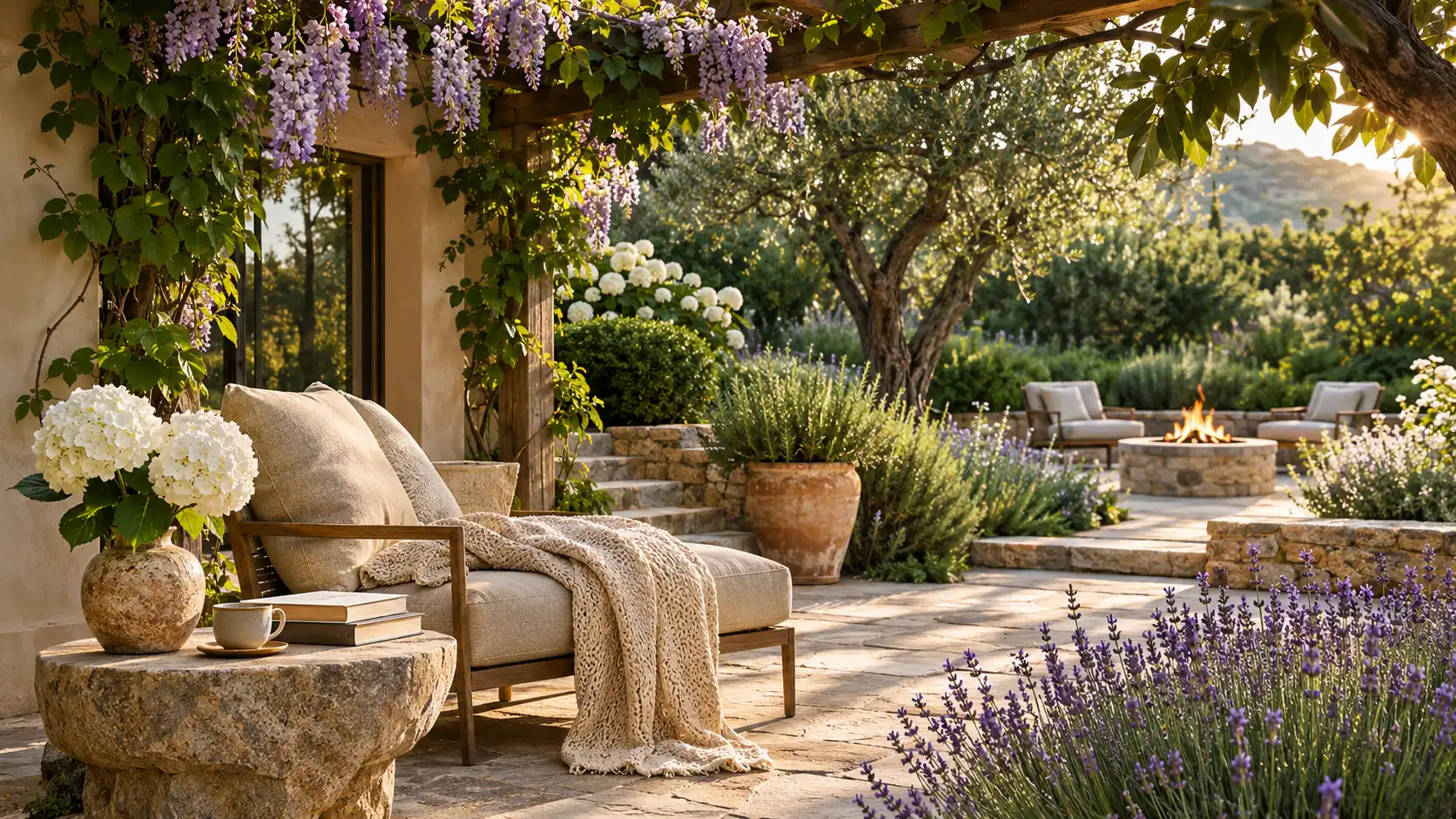
Luxury garden design with a shaded reading corner, natural stone terrace, lavender, olive trees, and an elegant outdoor fire pit.

Quiet Luxury Outdoors: Gardens Designed for Slow Living

Branching columns supporting the geometric vaults inside the Sagrada Família in Barcelona, captured with natural daylight reflecting off stone and stained glass.

Architecture Inspired by Nature’s Geometry: The Intelligence Behind Beautiful Forms

Yellow World Architecture Festival installation surrounded by visitors and exhibition stands inside the festival hall.

World Architecture Festival 2026: Dates, Speakers & Guide

A sweeping, translucent fabric canopy suspended over a silhouetted crowd, illuminated by warm, golden atmospheric lighting in a monumental industrial venue.

Dezeen Awards 2026: The Projects, Architects, and Ideas Shaping Contemporary Design

Glass fronted IFEMA Madrid exhibition centre with entrance doors, landscaped forecourt and purple bollards.

Interihotel 2026: Where Thoughtful Design Becomes Unforgettable Hospitality

DecorHotel Porto 2026 banner featuring an electronic hotel door lock and November 4–6 dates at EXPONOR in Matosinhos.

DecorHotel Porto 2026: A Guide to Hospitality Design and Innovation

Reader Favorites

Top 10 Interior Design Trends

Top 10 Interior Design Trends That Will Shape Homes After 2027

Design Miami 2026 - what to look for

Design Miami 2026: The Leading Global Fair for Collectible Design Returns in December

Close-up of artisan hands carving intricate patterns into wood, highlighting the precision and artistry of Italian craftsmanship.

How Artisanal Craftsmanship is Reclaiming its Place in Luxury Interiors

Latest News

Luxury garden design with a shaded reading corner, natural stone terrace, lavender, olive trees, and an elegant outdoor fire pit.

Quiet Luxury Outdoors: Gardens Designed for Slow Living

Branching columns supporting the geometric vaults inside the Sagrada Família in Barcelona, captured with natural daylight reflecting off stone and stained glass.

Architecture Inspired by Nature’s Geometry: The Intelligence Behind Beautiful Forms

Yellow World Architecture Festival installation surrounded by visitors and exhibition stands inside the festival hall.

World Architecture Festival 2026: Dates, Speakers & Guide

Join our Newsletter

Join our circle of refined living.
Subscribe for curated stories, news and inspiration.

Subscription Form